
DATA Series
Invasive Shrimp: No Small Matter
- Lesson Time : 45 minutes
- Grade Level : 6-12
- Vocabulary: invasive species, ballast, occurrence, distribution, range
- Data Source: Global Biodiversity Information Facility (GBIF)

Celia Cackowski
Author
Subject Area
Human Impacts, Biology & Ecology
Invasive Species, Global Migration
Focus
Download PDF
Summary
This lesson introduces students to human impacts on ecosystems by discussing introduced versus invasive species, movement of aquatic species through global shipping channels, and methods scientists use to track species across the globe. Students will work in groups to track the movement of invasive Oriental grass shrimp (Palaemon macrodactylus) over time using the Global Biodiversity Information Facility (GBIF) database. Students will then use collection data to map records by year and answer a series of questions.
Objectives
- Locate species occurrence data in GBIF
- Use collection data to map records by year
- Answer questions about species movement over time
Background Information
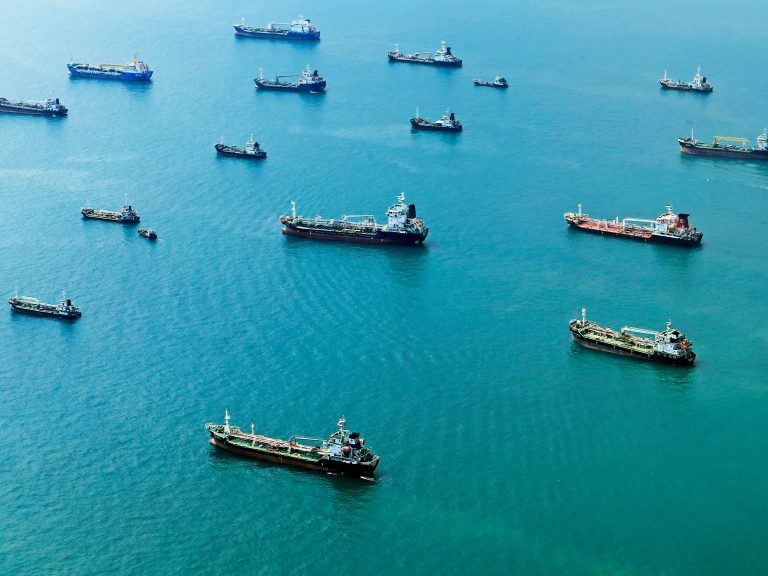
Commercial ships transport consumer goods and raw materials to ports worldwide. Most of these ships have large steel tanks, called ballast tanks, located along the sides and bottoms of their hulls. These tanks are filled and emptied as needed to keep the ship at a constant weight which is very important for stability in rough seas. When cargo is unloaded from a ship, the weight of the ship decreases, so seawater from the surrounding waters is pumped into the ballast tanks to compensate. When cargo is loaded onto a ship, the weight of the ship increases, so ballast water from the ballast tanks is discharged into the surrounding waters to offset the increased weight of the cargo.
The water pumped into a ship’s ballast tanks may contain numerous aquatic organisms, including viruses, bacteria, algae, jellyfish, crabs, mollusks, and fish. If the organisms within a ship’s ballast tanks survive the trip to the next destination, they may be released when the ballast water is discharged, introducing them into waters where they do not naturally occur. If these nonnative organisms survive and spread throughout their new environment, they may become invasive species. In this way, ballast water can accidentally introduce harmful microalgae and other organisms into the environment.
The Oriental grass shrimp, Palaemon macrodactylus, is native to Japan, Korea, and Northern China. P. macrodactylus naturally tolerates moderate salinity levels allowing it to inhabit a wide variety of habitats across the world, including brackish and marine coastal waters. This shrimp is easily identified from other similar species by the prominent orange-brown bands on the legs. The diet of P. macrodactylus typically consists of plants, mysids such as Neomysis mercedis, amphipods, and crabs. It favors pilings, walls, debris, and other forms of shelter as habitat. Even though P. macrodactylus has been classified as a highly invasive species in many regions worldwide, there is no published attempt to control the widespread and invasiveness of any population of the organism at the moment. P. macrodactylus was first reported on the West Coast of North America in the 1950s. It was first reported on the East Coast in 2001.
GBIF, the Global Biodiversity Information Facility, is an international network and data infrastructure funded by the world’s governments and aimed at providing anyone, anywhere, open access to data about all types of life on Earth. Students will use this database to see when and where P. macrodactylus has spread over time.
Data Activity
1. Review the marine invasive species video.
2. Break students into groups and distribute student worksheets and instructions.
3. Allow students time to locate and track the species over time.
4. Regroup to discuss the answers to worksheet questions and strategize about how to manage the issue..
Using the worksheet, mark map with locations and years and answer the following questions:
1. Where was Palaemon macrodactylus found in 1900?
2. What year did it first appear on the West Coast of the United States?
3. What year did it first appear on the East Coast of the United States?
4. What year did it first appear in the Chesapeake Bay?
5. How do you think this species was able to travel to these new locations?
Extensions:
1. Students may brainstorm possible solutions to ballast water/larvae problem.
2. Students may investigate species that are native to Chesapeake Bay (ie. blue crab) to see where in the world it is invasive.
3. Students may create a messaging campaign to alert companies and/or consumers of the issue of marine introductions through ship ballast water.
For more information, see:
Smithsonian Marine Invasives Lab Species Profile (Palaemon macrodactylus).